Uma configuração confiável de compressor e secador de ar não é definida por uma única sequência universal de equipamentos. A disposição correta depende do ponto de orvalho sob pressão necessário, da vazão de ar, da pressão operacional, da temperatura de descarga do compressor, do nível de contaminação, do perfil de demanda e dos requisitos de qualidade do ar no ponto de uso.
Uma instalação industrial típica pode incluir compressor, equipamentos de resfriamento e separação, capacidade de armazenamento, filtragem, secador de ar, drenagem de condensado e distribuição a jusante. O mais importante não é simplesmente instalar esses componentes, mas garantir que trabalhem em conjunto nas condições reais de operação.
Este guia explica como planejar uma configuração de compressor e secador de ar, onde os principais componentes se encaixam no sistema e quais erros de instalação podem reduzir o desempenho da secagem ou aumentar a queda de pressão.
O que é uma configuração de compressor e secador de ar?
Uma configuração de compressor e secador de ar é o conjunto completo utilizado para gerar, resfriar, armazenar, limpar, secar e distribuir ar comprimido.
Dependendo da aplicação, o sistema pode incluir:
- Compressor de ar
- Pós-resfriador ou outra etapa de resfriamento
- Separador ar-água
- Reservatório de ar comprimido
- Pré-filtragem
- Secador de ar por refrigeração ou por adsorção
- Filtragem a jusante
- Drenos de condensado
- Tubulações, válvulas e controles
Nem todos os sistemas exigem todos esses componentes exatamente na mesma posição. A disposição adequada deve começar pelos requisitos do processo e, em seguida, configurar a linha de tratamento de acordo com a qualidade de ar necessária e as condições reais de operação.
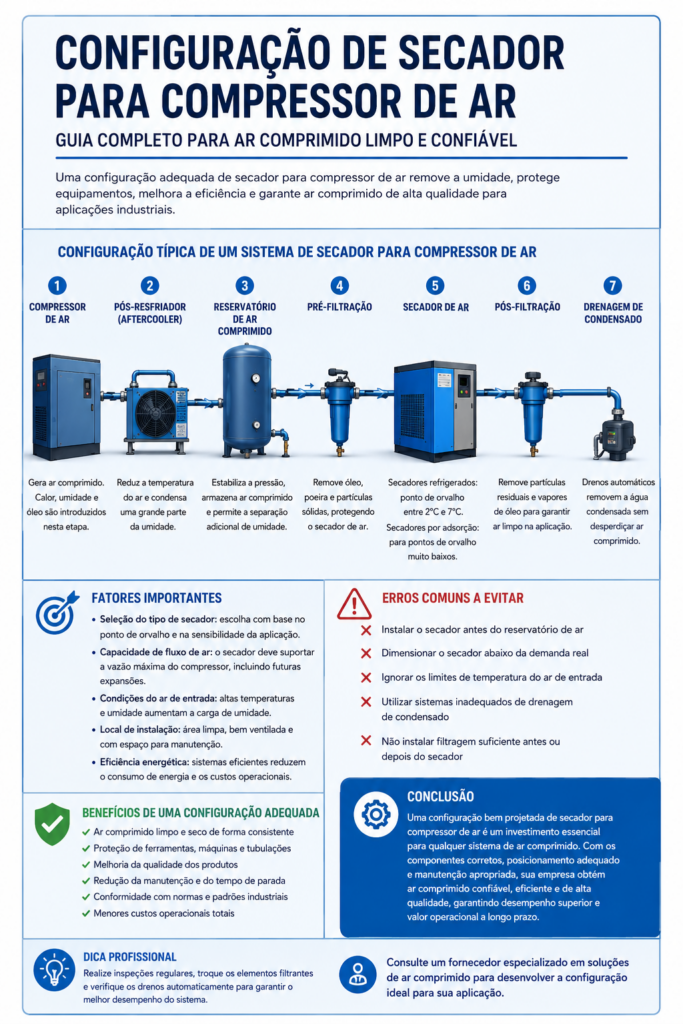
Etapa 1: comece pelas condições operacionais do compressor
Antes de selecionar ou posicionar o secador, determine quais condições de ar o compressor realmente enviará ao sistema de tratamento.
Os parâmetros importantes incluem:
- Vazão máxima e normal real
- Pressão de descarga do compressor
- Temperatura de descarga
- Perfil operacional do compressor
- Risco de arraste de óleo
- Temperatura e umidade ambientes
- Expansão futura prevista
A compressão aumenta a concentração de umidade no ar. À medida que o ar comprimido esfria, o excesso de vapor de água pode se condensar em água líquida. Água, óleo e partículas sólidas são problemas distintos de contaminação do ar comprimido e exigem métodos de tratamento adequados.
O secador deve, portanto, ser selecionado e instalado com base nas condições reais de entrada, e não apenas na vazão nominal indicada na placa do compressor.
Para uma visão mais ampla dessa relação, consulte o conteúdo sobre o projeto integrado de compressor e secador.
Etapa 2: remova o líquido em grande quantidade antes da secagem profunda
O ar comprimido que sai do compressor pode conter calor e umidade significativos. À medida que o ar esfria, forma-se condensado líquido.
Equipamentos de resfriamento, separadores, drenos e reservatórios podem ajudar a remover esse líquido em grande quantidade antes que o ar chegue aos componentes de tratamento mais sensíveis.
Isso é especialmente importante para secadores por adsorção, que são destinados principalmente à remoção de vapor de água, e não ao tratamento de grandes quantidades de água líquida de entrada.
Uma sequência prática de tratamento é:
Resfriar adequadamente o ar → separar o líquido condensado → drená-lo de forma confiável → realizar uma secagem mais profunda.
Uma falha no separador ou no dreno pode fazer com que um secador corretamente dimensionado pareça subdimensionado, porque passa a receber uma carga de umidade muito maior do que a prevista.
Etapa 3: determine onde a capacidade de armazenamento é necessária
Um reservatório de ar comprimido fornece armazenamento e pode ajudar a estabilizar variações de curta duração na vazão e na pressão.
No entanto, não existe uma regra universal que determine que o reservatório sempre precise ficar antes do secador.
Um reservatório antes do secador pode ajudar a fornecer armazenamento e estabilizar as condições de entrada no sistema de tratamento.
Um reservatório depois do secador pode armazenar ar comprimido já tratado e ajudar a atender picos de demanda de curta duração a jusante.
Alguns sistemas podem utilizar armazenamento nos dois lados.
A disposição correta depende:
- Do controle do compressor
- Do perfil de demanda
- Da estratégia de gerenciamento de condensado
- Da qualidade de ar necessária
- Do espaço disponível para instalação
Para uma explicação mais detalhada, consulte o conteúdo sobre o uso conjunto de reservatório de ar comprimido e secador.
Etapa 4: instale a pré-filtragem adequada
Não se deve esperar que os secadores removam todos os contaminantes do ar comprimido.
Óleo, partículas sólidas e umidade são problemas de tratamento distintos.
Filtros a montante podem ajudar a proteger componentes internos do secador, válvulas, adsorvente, trocadores de calor e equipamentos a jusante contra contaminação.
A configuração necessária de filtragem depende do tipo de compressor e dos requisitos finais de qualidade do ar.
A filtragem para remoção de óleo e partículas pode, portanto, fazer parte do sistema completo de purificação de ar comprimido, inclusive em aplicações onde a remoção de óleo é necessária antes de uma etapa de adsorção.
Um filtro de precisão para ar comprimido pode ser incorporado à configuração quando o nível de filtragem especificado assim exigir.
Etapa 5: escolha o secador de acordo com o ponto de orvalho necessário
O tipo de secador deve ser selecionado de acordo com o ponto de orvalho sob pressão exigido pelo processo a jusante.
Secador de ar por refrigeração
Um secador de ar por refrigeração resfria o ar comprimido para que a umidade se condense e possa ser separada.
Os sistemas de secagem por refrigeração da Lingyu podem operar com ponto de orvalho sob pressão de aproximadamente 2–10 °C, dependendo do sistema e das condições operacionais.
Esse tipo de secador é adequado quando uma remoção moderada de umidade atende aos requisitos do processo.
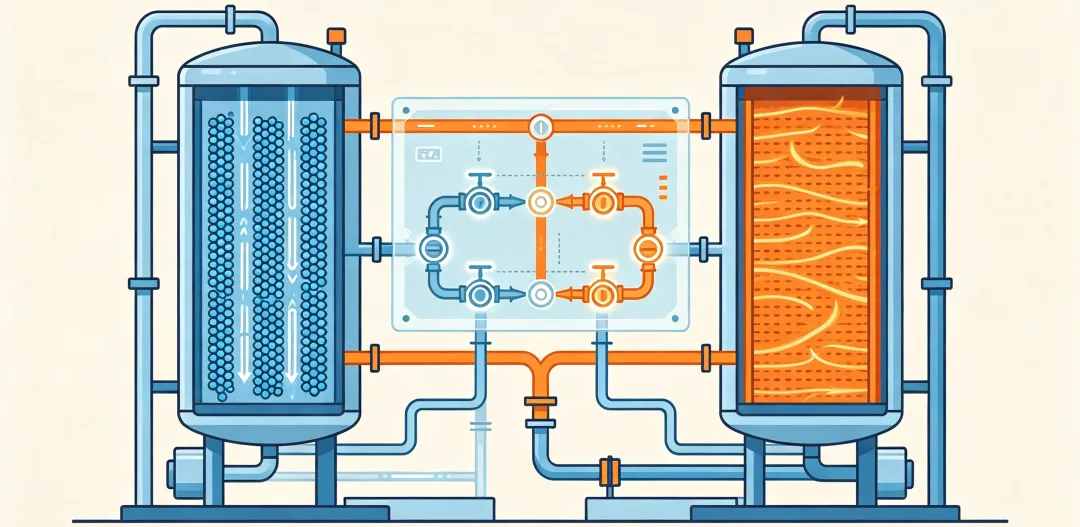
Secador de ar por adsorção
Um secador de ar por adsorção remove vapor de água por adsorção e pode atingir pontos de orvalho sob pressão substancialmente menores.
Por exemplo, a série regenerativa HH sem aquecimento da Lingyu especifica ponto de orvalho sob pressão na saída de ≤−40 °C nas condições operacionais indicadas.
Outras famílias de secadores por adsorção da Lingyu oferecem diferentes configurações de ponto de orvalho.
O secador correto deve, portanto, ser selecionado de acordo com os requisitos reais do processo, em vez de escolher um secador por adsorção simplesmente porque a aplicação parece exigir um tratamento mais avançado.
Etapa 6: compatibilize a capacidade do secador com as condições reais de operação
Um secador não deve ser dimensionado apenas com base na vazão nominal do compressor.
A capacidade real do secador pode ser afetada por:
- Temperatura de entrada
- Pressão de entrada
- Vazão real
- Carga de umidade
- Condições ambientais
- Ponto de orvalho necessário
Por exemplo, o secador HRB-E da Lingyu, aquecido por soprador com baixa purga, possui pressão nominal de entrada de 0,7 MPa, faixa operacional de 0,6–1,0 MPa, temperatura nominal de entrada de 10–30 °C e temperatura máxima de entrada de ≤40 °C.
Esses valores representam condições operacionais dessa família de modelos, e não valores universais para todos os secadores.
Ao projetar a configuração, compare a produção prevista do compressor e as condições da instalação com a base de classificação do secador efetivamente selecionado.
Etapa 7: considere a secagem combinada quando o processo justificar
Alguns sistemas utilizam secagem por refrigeração e por adsorção em sequência.
Em um sistema de secagem combinada, o ar comprimido é primeiro pré-resfriado e submetido à secagem por refrigeração, reduzindo seu teor de umidade antes de entrar na etapa de adsorção.
Isso reduz a carga de umidade sobre o sistema de adsorção, diminui o consumo de ar de regeneração e ajuda a prolongar a vida útil do dessecante.
Isso não significa que todos os sistemas de ar comprimido devam instalar dois secadores.
A secagem combinada é apropriada somente quando o ponto de orvalho necessário, as condições operacionais, o balanço energético e o custo do ciclo de vida justificarem a etapa adicional de tratamento.
Etapa 8: instale filtragem a jusante quando necessário
Depois do secador, ainda pode ser necessária filtragem, dependendo da aplicação e do tipo de secador.
Por exemplo, um secador por adsorção pode gerar partículas finas de dessecante ao longo do tempo, de modo que uma filtragem de partículas a jusante pode ser utilizada para evitar seu arraste para o sistema de distribuição.
Em sistemas de secagem combinada, um filtro de partículas de alta eficiência após a etapa de adsorção pode remover pó residual e partículas do dessecante.
O grau necessário do filtro a jusante deve ser selecionado de acordo com a especificação real de qualidade do ar.
Não se deve presumir que uma única configuração genérica de pós-filtro seja adequada para todos os processos.
Etapa 9: projete a drenagem de condensado como parte do sistema
A remoção de condensado é parte integrante do sistema de tratamento de ar comprimido.
A água coletada em separadores, reservatórios, filtros ou secadores deve ser descarregada de forma confiável.
Se os drenos falharem, a água líquida pode seguir para os equipamentos a jusante e aumentar a carga de umidade do secador ou contaminar o sistema de ar comprimido.
A seleção do dreno deve considerar:
- Volume de condensado
- Pressão do sistema
- Horas de operação
- Requisitos de manutenção
Selecione um sistema de drenagem que remova o condensado de forma confiável, minimizando perdas desnecessárias de ar comprimido.
Etapa 10: controle a queda de pressão em todo o sistema
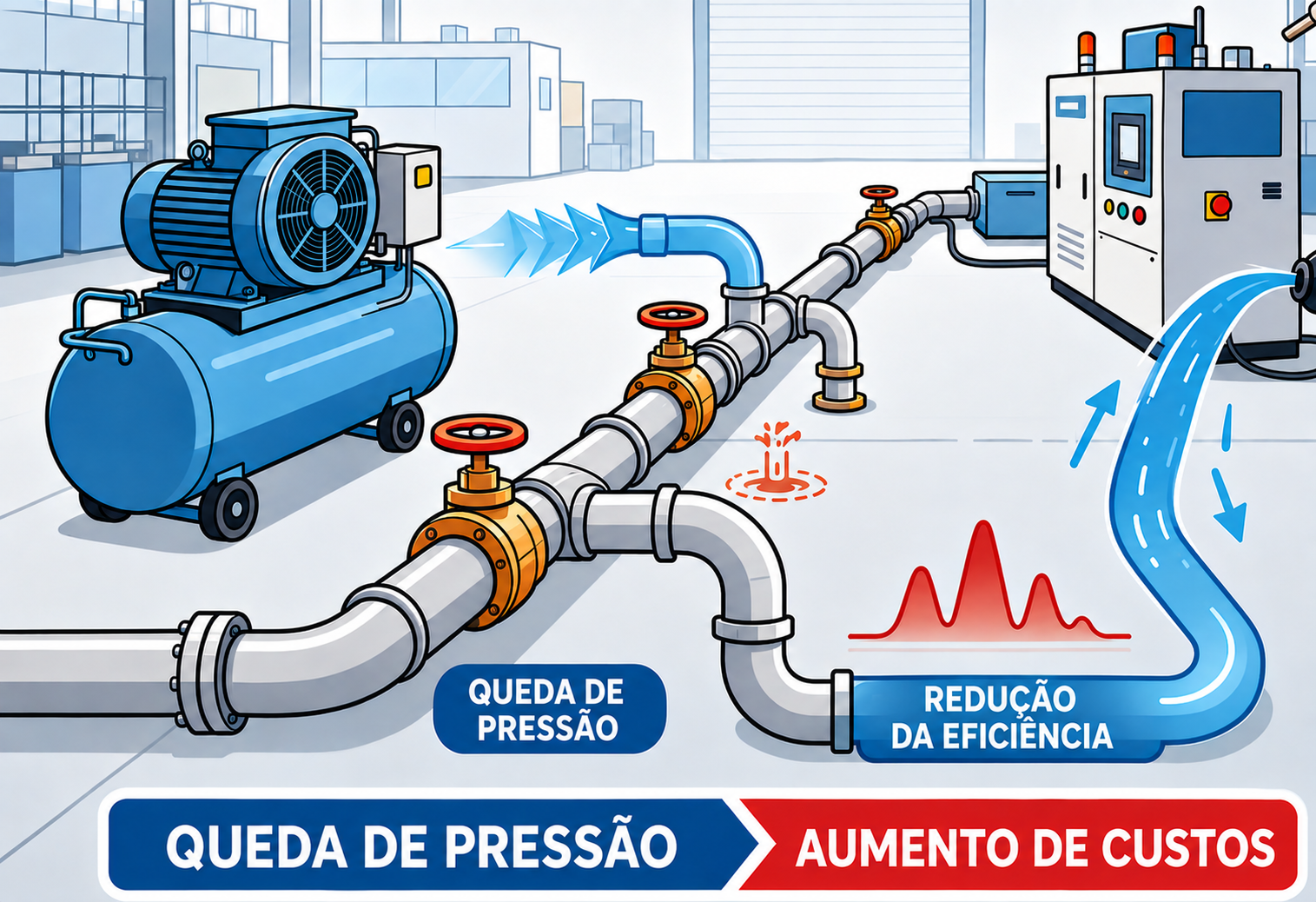
Uma configuração de secagem pode atingir o ponto de orvalho necessário e ainda apresentar desempenho insatisfatório se o sistema gerar perda excessiva de pressão.
A queda de pressão pode ocorrer em:
- Separadores
- Filtros
- Secadores
- Válvulas
- Tubulações
- Conexões
- Elementos filtrantes contaminados
O projeto deve, portanto, ser baseado na pressão necessária no ponto final de uso, e não apenas na pressão de descarga do compressor.
Tubulações subdimensionadas ou uma queda excessiva de pressão no tratamento podem levar os operadores a aumentar desnecessariamente a pressão do compressor, elevando o custo operacional.
Etapa 11: deixe espaço suficiente para resfriamento e manutenção
A disposição da instalação deve favorecer tanto o desempenho dos equipamentos quanto sua manutenção.
O secador deve ter espaço suficiente para:
- Substituição de filtros
- Manutenção de válvulas
- Manutenção dos drenos
- Trabalhos elétricos
- Limpeza de trocadores de calor, quando aplicável
- Manutenção do dessecante, quando necessária
Os requisitos de resfriamento também dependem do tipo de secador.
Equipamentos refrigerados a ar exigem ventilação adequada ao redor das superfícies de dissipação de calor, enquanto projetos refrigerados a água exigem as condições especificadas de água de resfriamento.
Não posicione os equipamentos apenas de acordo com o caminho mais curto da tubulação se isso dificultar a manutenção de rotina ou restringir o fluxo de ar necessário.
Etapa 12: verifique a configuração antes do comissionamento
Antes da operação normal, verifique se a instalação corresponde às condições de projeto dos equipamentos.
Verifique:
- Direção do fluxo de ar
- Posições das tubulações e válvulas
- Pressão e vazão do compressor
- Pressão e temperatura de entrada do secador
- Funcionamento do separador e dos drenos
- Instalação dos filtros
- Sequência operacional do secador
- Ponto de orvalho na saída
- Pressão diferencial
- Configurações de alarmes e proteções
- Configuração do bypass
- Pressão a jusante
Registre os valores de referência durante o comissionamento.
Essas leituras fornecem referências úteis para o diagnóstico de futuros aumentos no ponto de orvalho ou na queda de pressão.
Erros comuns na configuração de compressor e secador de ar
Vários problemas de instalação e seleção podem reduzir o desempenho de um sistema de tratamento de ar comprimido que, de outra forma, seria adequado.
Dimensionar apenas pela vazão nominal do compressor
Temperatura, pressão, vazão, carga de umidade e condições reais da instalação podem alterar o desempenho do secador.
A seleção deve ser baseada nas condições reais de operação.
Permitir que água líquida chegue a um secador por adsorção
Falhas na separação ou drenagem podem aumentar substancialmente a carga de umidade que entra na etapa de adsorção e reduzir o desempenho da secagem.
Utilizar o secador errado para o ponto de orvalho necessário
Um ponto de orvalho menor deve ser especificado porque o processo realmente exige, e não simplesmente porque um secador por adsorção parece mais avançado.
Ignorar a queda de pressão
Um sistema de ar limpo não consegue cumprir sua função se os equipamentos de produção não receberem a pressão operacional necessária.
Filtragem inadequada
Óleo e partículas sólidas podem contaminar válvulas, secadores, adsorventes e equipamentos a jusante.
A filtragem deve, portanto, ser selecionada como parte do sistema completo de tratamento de ar.
Tratar a posição do reservatório como uma regra universal
A posição do reservatório deve ser determinada pela função do sistema, pelo controle do compressor, pelas características da demanda e pelos requisitos de gerenciamento de condensado, em vez de seguir um único diagrama fixo de tubulação.
Ignorar o acesso para manutenção e a ventilação
Uma boa configuração de tubulação não deve tornar o secador, os filtros, os drenos ou outros equipamentos de tratamento difíceis de manter nem restringir o fluxo de ar exigido por equipamentos refrigerados a ar.
Como selecionar a configuração final de compressor e secador
Uma sequência prática de projeto do sistema é:
Requisito de qualidade do ar do processo → ponto de orvalho necessário → vazão e demanda de pico → pressão no ponto de uso → condições operacionais do compressor → resfriamento e separação → estratégia de armazenamento → filtragem → tipo e capacidade do secador → drenagem de condensado → distribuição → monitoramento
Se você ainda estiver escolhendo entre diferentes tecnologias de secagem, o guia de seleção de secadores de ar comprimido deve ser utilizado antes de finalizar a disposição da instalação.
Conclusão
Uma configuração confiável de compressor e secador de ar não é criada seguindo um único diagrama fixo de tubulação.
Ela resulta da compatibilização do compressor, equipamentos de resfriamento e separação, capacidade de armazenamento, filtros, secador, drenos e sistema de distribuição com os requisitos reais de operação.
Os fatores mais importantes são:
Vazão → pressão → temperatura de entrada → carga de umidade → ponto de orvalho necessário → filtragem → estratégia de armazenamento → queda de pressão → drenagem → acesso para manutenção
Quando essas variáveis são consideradas em conjunto, o sistema de ar comprimido tem maior probabilidade de fornecer qualidade de ar estável e desempenho confiável, sem tratamento desnecessário ou perdas operacionais evitáveis.